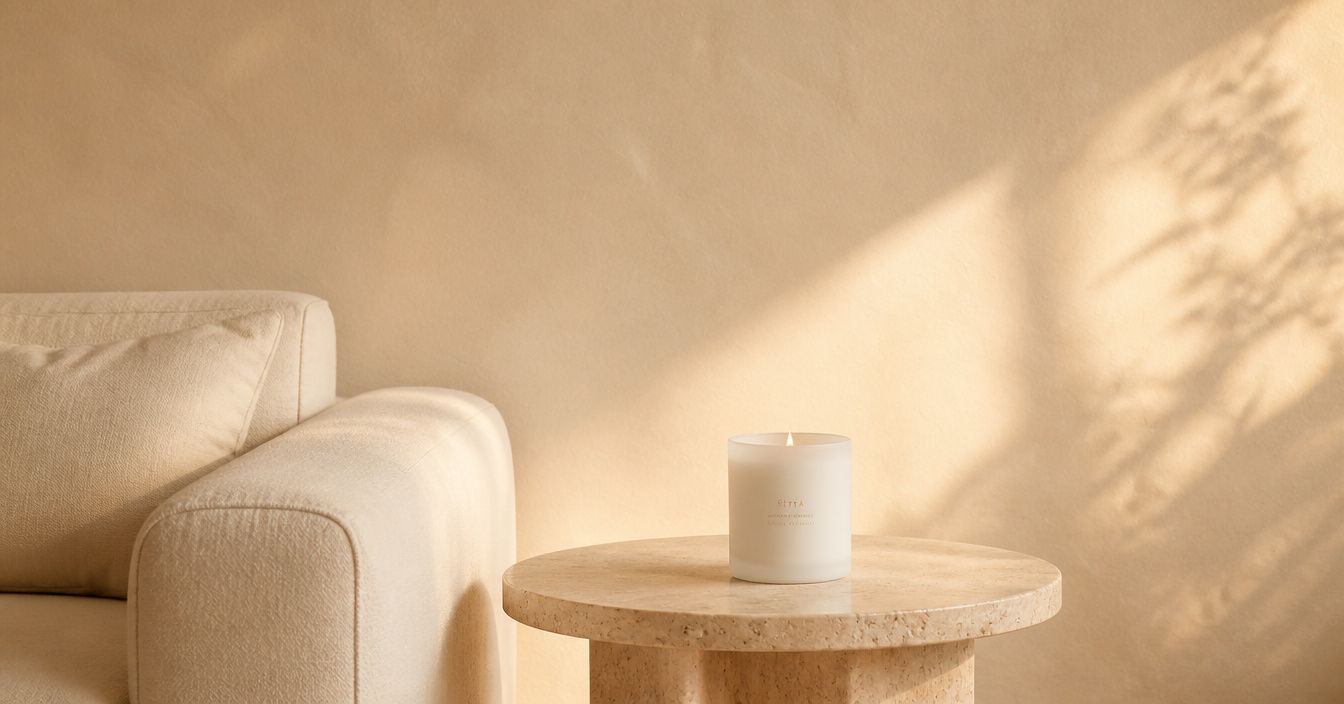
Candle Placement 101: Better Scent + Cleaner Burn
Updated: 2 days ago
Where you put a candle changes two systems at once: the flame and the fragrance.
A spot can look perfect and still sit directly beneath an HVAC vent. A corner can smell powerful when you stand beside it but do little for the part of the room where you actually sit.
Good placement therefore has two jobs: support a stable, safer burn and put fragrance where the room can use it.
Start with the flame, not the scent
A lit candle is an open flame. Before thinking about fragrance throw, choose a stable location with appropriate clear space, away from combustible material and places where children, pets, sleeves, bags, or traffic can knock the candle over.
If a location is not safe for the flame, better scent performance does not make it a good location.
Avoid direct drafts
The National Candle Association describes a calm, steady flame as a sign of balanced burning. Constant flickering or visible wisps of smoke can occur when moving air disturbs the flame.
Common sources include:
HVAC vents
fans
open windows
frequently opened doors
strong air purifiers
busy walkways.
A draft can do more than make the flame look restless. It can distort combustion, encourage uneven burning, and increase visible soot.
Laboratory research reinforces the general principle. In a controlled chamber study of five pillar-candle types, deliberately stressed burning produced soot-dominated particle emissions. That study was not a test of every container candle, but it supports the practical reason to avoid constant forced flicker.
Normal room ventilation is not the enemy. The goal is normal fresh-air exchange while keeping the candle out of the path of a vent or fan: normal ventilation in the room, stable air at the flame.
Think in scent zones, not square feet
Candle advice often tries to turn room size into an exact formula: X ounces for Y square feet.
That sounds precise. It usually is not.
Floor area is only one variable. Ceiling height, open doorways, furniture, textiles, HVAC, connected rooms, and where people actually spend time all affect how fragrance is experienced.
A more useful question is: Which part of the room do I want to scent?
The seating area.
The entry.
The reading corner.
The area where people gather before dinner.
A candle does not need to dominate every cubic foot of an open floor plan to succeed. It needs to create an appropriate presence in the zone that matters.
Place for circulation, not direct wind
Fragrance released from a burning candle travels through surrounding air. Some ordinary circulation helps distribute it. A strong current can destabilize the flame and move fragrance away from the intended zone before it establishes a useful presence.
The best location is often neither a dead corner nor the strongest airflow path.
Choose a stable, heat-resistant surface where normal room circulation can carry fragrance outward. If you need to reposition a candle that has been burning, extinguish it and wait until both the vessel and wax have cooled completely before moving it.
move a candle away from a supply register
bring it out of an isolated alcove
place it closer to the occupied part of the room without putting it in traffic.
There is no universal best coordinate. Watch what the room does.
Use doorways carefully
Doorways can move fragrance between spaces, but they also create traffic, door movement, pressure changes, pets, and bags.
Do not place a flame in the traffic path simply because scent carries well there. Think near the entry zone, not in the doorway.
Be careful with shelves and enclosed spaces
A candle needs clear space above and around the flame.
Do not burn one beneath a low shelf, cabinet, hanging decoration, plant, or other object that can heat up or ignite.
A recessed niche can look elegant in a photograph while being a poor place for a live flame. Photography placement and burn placement do not have to be the same.
Windows can change the local airflow
An open window can create a direct draft. Even a closed cold window can create local convection as warm indoor air meets cooler glass.
If the flame noticeably bends or flickers near a window, move the candle inward after extinguishing and cooling it. Do not solve an unstable flame by eliminating all ventilation; choose a better burn location.
HVAC season can change a room without moving the furniture
A candle location that works in early fall may behave differently once forced-air heat runs frequently.
The furniture has not moved. The air has.
Is a supply register active?
Is a return pulling air across the room?
Is a ceiling fan running?
Are interior doors staying closed more often?
Has the candle moved closer to a cold window?
Placement is not permanent. The room is a changing system.
A five-minute placement check
Light the candle according to its care instructions.
Observe the flame from a normal distance. Is it mostly calm and upright?
If it repeatedly leans or flickers, identify nearby moving air.
Check above and around the candle for combustible or heat-sensitive material.
Sit where you normally use the room.
After the candle has had appropriate time to establish fragrance, notice whether scent reaches that zone naturally.
If the flame is stable but fragrance is trapped in an unused corner, try another safe location after extinguishing and cooling the candle.
You are tuning two systems. Do not sacrifice flame behavior for scent throw—or scent usefulness for styling.
Placement cannot fix every candle
A stable location helps a well-designed candle perform as intended. It cannot repair every problem.
If a candle repeatedly develops an oversized flame, excessive soot, wick instability, abnormal vessel heat, or other unsafe behavior despite correct use in a stable location, stop treating placement as the only variable.
Follow the manufacturer’s instructions and discontinue the burn if conditions become unsafe.
The simplest placement rule
Put the candle where the flame can stay calm, the surroundings are safe, you can supervise it, and the fragrance can reach the part of the room you actually use.
That is more useful than chasing a universal square-foot formula. A candle changes the atmosphere through both fire and fragrance. Respect both.


Comments